
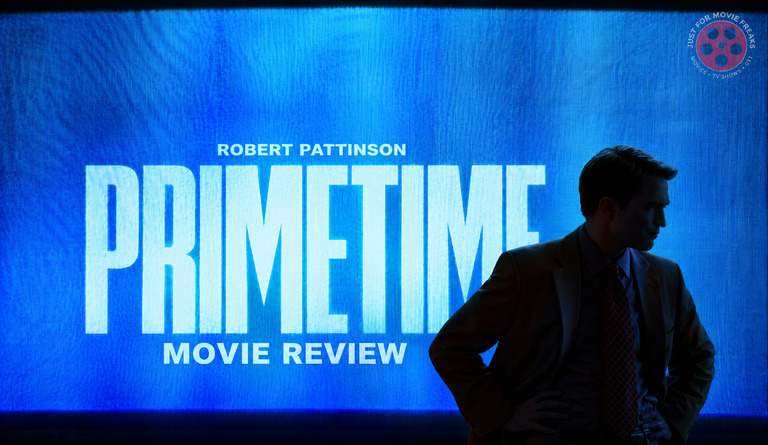
Primetime (2026) Review: An Engaging Media Satire!
The world of television has always had an interesting relationship with morality, particularly when real-life crime and human suffering become sources of entertainment. Primetime, directed by Lance Oppenheim, explores this uneasy relationship through the rise of a sensational true-crime television show inspired by To Catch a Predator, examining the people behind its production and the ethical compromises that emerge when justice becomes a ratings-driven business. Starring Robert Pattinson, Merritt Wever and Skyler Gisondo, the film takes us into the world of early-2000s reality television, where the pursuit of audience attention gradually blurs the boundaries between exposing wrongdoing and exploiting it for entertainment.
Also Read – “Resident Evil (2026)” Review: Entertaining Survival-Horror!
Set in 2006, Primetime follows Chris Hansen (played by Robert Pattinson), a television journalist who becomes a national sensation through a weekly hidden-camera sting operation targeting alleged sexual predators. As the show gains popularity and its ratings continue to rise, the pressure to deliver increasingly sensational content begins to affect the people involved in its production.
Going into Primetime , I was familiar with the name Chris Hansen and knew about To Catch a Predator, but I had never actually watched an episode of the show. This meant I approached the film with very little knowledge of the real-life programme or its host, and after watching the trailer, I was expecting something along the lines of Nightcrawler (2014), one of my favourite films of all time.
While Primetime explores some similar territory in terms of media sensationalism, obsession and the questionable morality of individuals operating within the television industry, it takes a different approach to its subject. I was particularly intrigued by the prospect of seeing how such a controversial show was produced, how much involvement Hansen had in its operations and what went on behind the cameras.
One of the first things that stands out about Primetime is its visual presentation. The film’s 4:3 aspect ratio immediately establishes a distinct early-to-mid-2000s television aesthetic, effectively recreating the look and atmosphere of the CRT television era. Combined with its heavy film grain, noisy textures and deliberately retro visual style, the presentation gives the film a convincing sense of time and place. Cinematographer David Bolan does excellent work throughout, making effective use of close-up shots, tight framing and intimate camera angles that keep the focus firmly on the characters and their performances.
The lighting, colour palette and production design further enhance the period atmosphere, while the relatively confined visual composition also contributes to the film’s tense and sometimes suffocating mood. I particularly liked how the cinematography allows the characters’ facial expressions and subtle reactions to carry much of the emotional weight. Ari Balouzian’s background score is another major highlight, adding an unsettling and distinctive quality to the film while complementing its darkly satirical tone.
Robert Pattinson delivers a strong performance as Chris Hansen, portraying him as a complicated, ambitious and morally ambiguous figure. Since I have not watched Hansen’s original television work, I cannot comment on how closely Pattinson captures his actual accent, mannerisms or speech patterns. However, judging the performance on its own, Pattinson does a very good job of portraying a character who moves between confidence, obsession, frustration and vulnerability. He brings considerable depth to this anti-hero, making Hansen an intriguing presence even when his decisions become increasingly questionable.
Merritt Wever was another standout for me. Her character plays an important role in the story, and Wever brings a convincing sense of complexity and purpose to the performance. Skyler Gisondo is equally effective as Dan Plum, offering a different perspective on the production and the personal circumstances of someone drawn into this unusual working environment. I appreciated that the film gives these characters meaningful attention rather than making everything revolve exclusively around Hansen.
As a story, Primetime is an engaging watch, particularly because of the insight it offers into the inner workings of a sensational television production. The film explores how the show operates, how its various team members contribute to its success and how the pressure to maintain high ratings can influence their decisions. The psychological aspects of Hansen’s character are especially interesting, as are the different motivations and perspectives of the people around him. There is a consistent sense of intrigue throughout the runtime, and the film does a good job of keeping the audience invested in what is happening behind the scenes.
However, I did feel that Oppenheim’s treatment of the material was overly dramatic at times. Given the already disturbing and uncomfortable nature of the subject matter, I was expecting the behind-the-scenes activities to reveal more genuinely unsettling or deeply disturbing behaviour from Hansen and the production team. Instead, some of the situations felt exaggerated in a way that did not entirely convince me. The subplot involving Hansen and his work from India, in particular, felt overemphasised, and certain developments seemed designed to make the production appear more psychologically extreme than what the story itself established.
Ultimately, Primetime is a well-crafted and engaging media satire that explores the complicated relationship between entertainment, morality and the pursuit of ratings. Its strongest elements are its excellent cinematography, immersive retro aesthetic, atmospheric background score and compelling performances, particularly from Pattinson, Wever and Gisondo.
While I found some of the dramatic choices excessive and felt that the film occasionally overplayed the darker aspects of its story, its exploration of how a moral crusade can become entangled with commercial interests remains compelling. Primetime raises worthwhile questions about the ethics of televised justice and the role audiences play in consuming real-life suffering as entertainment. Although it did not entirely deliver the level of psychological intensity I had anticipated, it remains a visually distinctive and thought-provoking film that offers an intriguing look behind the cameras of a controversial television phenomenon.
‘Primetime (2026)’ Rating – 3.5/5

- Short Film Review: Honeywell – Complete and Thoughtful! - October 26, 2026
- Short Film Review: Secret Menu Beauty Pageant – An Offbeat Surreal Horror-Comedy! - October 24, 2026
- The Worth of Life Review: Unconventional and Thought-Provoking! - October 23, 2026




Pingback:Paper Tiger (2026) Review: A Fresh Entry in the Mob Drama Genre! - Just for Movie Freaks