
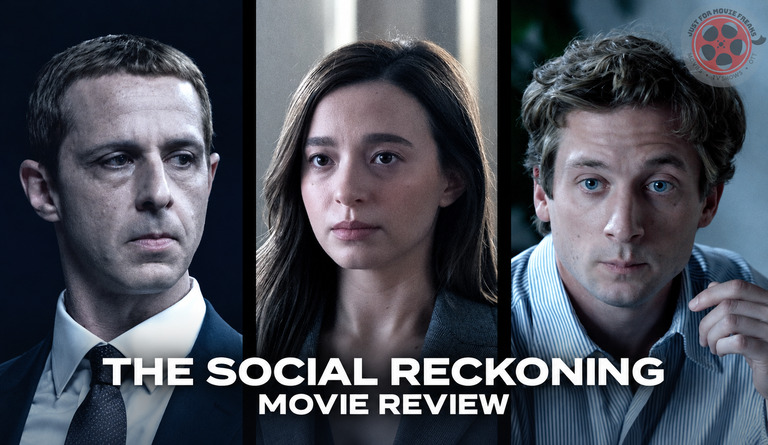
The Social Reckoning Review: A Timely Thought-Provoking Drama!
Social media was supposed to bring people closer together, give everyone a voice and make information more accessible than ever before. But what happens when the platforms designed to connect us begin amplifying hatred, encouraging addiction and influencing how millions of people think? With The Social Reckoning, writer-director Aaron Sorkin turns his attention to the darker consequences of social media, exploring the conflict between profits and public responsibility through the story behind the explosive Facebook Files.
Also Read – “Fjord (2026)” Movie Review: Layered and Beautifully Crafted!
Set between 2019 and 2021, the film follows Frances Haugen (Mikey Madison), a data scientist who joins Facebook hoping to help the company combat misinformation and make its platform safer. However, she discovers internal research suggesting that the company’s engagement-driven algorithms contribute to real-world harm, political radicalization and mental health problems among teenagers.
Frustrated by the company’s unwillingness to address these concerns, Frances takes the risk of copying thousands of pages of internal documents and working with Wall Street Journal reporter Jeff Horwitz (Jeremy Allen White). Their investigation eventually leads to the publication of the Facebook Files, exposing the company’s internal struggles and its priorities. Meanwhile, Mark Zuckerberg (Jeremy Strong) and the corporate hierarchy face growing scrutiny over the decisions that allowed the platform’s problems to persist.
As expected from an Aaron Sorkin film, The Social Reckoning is heavily driven by its screenplay, with dialogue, investigative processes and the exchange of information forming the backbone of the narrative. I was locked in throughout, largely because the subject matter genuinely interests me. However, I can understand why some viewers might find the film less engaging. It explores how the investigation of the Facebook Files began, the risks associated and the internal workings of the journalistic and corporate machinery.
What makes the film particularly compelling is how relevant its central concerns remain. Although the story takes place between 2019 and 2021, its questions about social media’s influence on society feel especially pertinent in today’s world. Across the political spectrum, online platforms can amplify extreme opinions, encourage hostility and expose users to increasingly polarized and hateful content.
The film examines how engagement-driven algorithms can contribute to radicalization, including among younger audiences, by repeatedly feeding users content that reinforces their existing beliefs. When you consider the hatred, misinformation, protests and political divisions visible around the world, the question of how much responsibility social media companies bear for what happens on their platforms becomes difficult to ignore. The film focuses specifically on Facebook and its corporate ecosystem rather than attempting to cover every major platform, but its broader questions about accountability extend well beyond a single company.
One of the most disturbing aspects of the story is the suggestion that the people running these platforms may understand the damage their products can cause while continuing to prioritize engagement and profitability. The film presents Zuckerberg as the central embodiment of this conflict, highlighting the decisions made when growth and advertising revenue compete with public welfare.
The issue isn’t simply that social media can be used to spread harmful content; it is the possibility that the systems governing what people see can actively reward the behaviour that keeps them engaged, even when that engagement comes at a considerable social cost. The film’s criticism of Zuckerberg centres on this apparent willingness to place business interests above broader human consequences. It raises an uncomfortable question: if a company knows that its product can cause harm and has the ability to address it, how much responsibility does it bear when it chooses not to act decisively and when the consequences affect society as a whole?
The performances are another major strength. Jeremy Allen White is excellent as Jeff Horwitz, portraying him as an old-school investigative reporter with a meticulous, distinctive approach to his work. His character brings a grounded journalistic perspective to the story, and White effectively conveys the persistence required to investigate a corporation with enormous resources and influence.
Mikey Madison is equally compelling as Frances Haugen. Alongside her screen presence and glamour, Madison delivers a strong performance that captures the character’s growing disillusionment and determination. Frances’s journey gives the film an important emotional dimension, as she moves from wanting to improve the company from within to recognizing that exposing its internal problems may be the only way to accountability. Her character arc is handled effectively, making the personal risks an important part of the story.
Jeremy Strong also does a terrific job as Mark Zuckerberg. What I particularly appreciated was the balance he strikes between portraying Zucc as a calculating businessperson and giving him an almost robotic quality. Comparing his performance with Jesse Eisenberg’s portrayal in The Social Network is inevitable, but I don’t think Strong needs to replicate Eisenberg’s interpretation. Eisenberg suited the earlier version of Zuckerberg portrayed in that film, while Strong feels well suited to this later period.
Ultimately, The Social Reckoning is a thought-provoking and timely drama that shifts the focus from technological innovation to the responsibilities that come with enormous digital power. Its dialogue-heavy screenplay may not appeal to everyone, but its exploration of corporate accountability, online radicalization and the consequences of prioritizing engagement over public welfare gives it considerable relevance. Sorkin keeps the story focused on the investigation behind the Facebook Files, while the performances of Mikey Madison, Jeremy Allen White and Jeremy Strong bring depth to the people at the centre of the controversy.
More than simply revisiting Facebook’s troubled history, the film encourages viewers to think critically about the platforms they use and the systems shaping their online experiences. In a world where social media increasingly influences how people think, interact and respond to one another, The Social Reckoning offers a timely reminder that the power to connect millions of people also comes with a responsibility that cannot simply be measured in clicks, engagement or profits.
‘The Social Reckoning’ Rating – 3.75/5

- The Social Reckoning Review: A Timely Thought-Provoking Drama! - October 21, 2026
- Hear Me (2026) Review: An Atmospheric Horror! - October 15, 2026
- Heart of the Beast Review: Friendship Against All Odds! - October 15, 2026