
I’d Rather Be Turned Into Cat Food Review: Genuinely Distinctive!
I’d Rather Be Turned Into Cat Food is a film that finds an unusual way to explore some of life’s most complicated questions, using crude humour, unconventional animation and a series of deeply philosophical conversations. Written and directed by Walter Santucci, this experimental comedy follows a disillusioned former musician who has lost faith in almost everything around him.
Related – “Resident Evil (2026)” Movie Review: Surpisingly Hilarious!
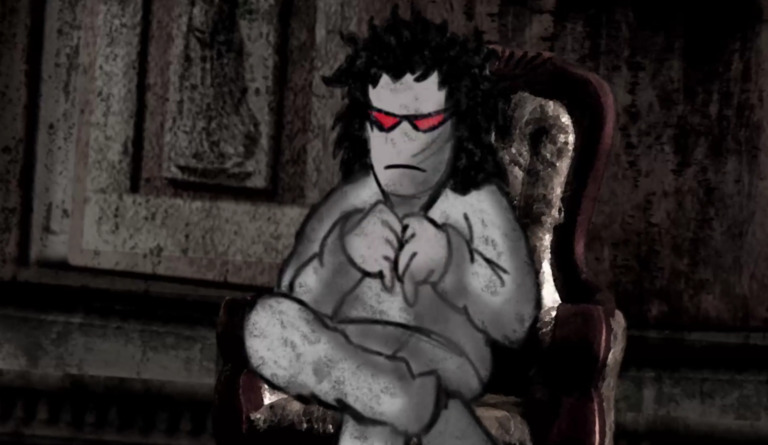
Set primarily within the confines of a crumbling, abandoned church, the film unfolds as an extended conversation between its protagonist and two irreverent, Muppet-like characters, Satchmo and Foo. What initially appears to be an absurd adult puppet show gradually develops into a thought-provoking exploration of existence, morality, religion, suffering and the human condition.
The story centres on Human, a failed punk musician who has become deeply cynical and disillusioned with life after his ambitions and relationships fall apart. Subsequently, he finds himself questioning the very foundations of existence, including the nature of God, the morality of love and whether the world itself is inherently evil.
His solitude is interrupted by Satchmo and Foo, two unconventional characters who challenge his beliefs, engage him in heated philosophical debates and occasionally offer perspectives that are surprisingly sincere. Through these conversations, alongside glimpses into Human’s troubled past, the film gradually reveals the experiences and disappointments that have shaped his nihilistic worldview.
What I particularly liked about I’d Rather Be Turned Into Cat Food is how deeply philosophical it is without relying on a conventional narrative structure. Almost the entire film is driven by conversations between Human, Satchmo and Foo, with the characters debating everything from the existence of God and the morality of nature to the role of human beings in a seemingly indifferent universe.
View this post on Instagram
One particularly interesting aspect of these discussions is the suggestion that human instincts, such as fear, greed, possessiveness and the desire for survival, can conflict with kindness and compassion. This leads to a broader question about whether being genuinely good requires us to resist our own nature. The film also explores the possibility that people have the agency to challenge destructive systems and create a more compassionate world, even if Human struggles to believe that such change is possible. These conversations are often provocative and frequently thought-provoking, giving the film a distinct philosophical identity.
What makes these discussions even more engaging is the attention given to Human’s background and the circumstances that have contributed to his outlook on life. His experiences as a musician, his failed ambitions and his rejection by the people around him, including being judged for his appearance, help explain why he has become so resentful and disconnected. The film offers a deeper look into the disappointments, betrayals and emotional wounds that have shaped his personality.
Ordinarily, a film built almost entirely around conversations could easily become monotonous, particularly when it lacks the narrative momentum of a conventional drama. However, I’d Rather Be Turned Into Cat Food managed to keep me engaged throughout, and much of the credit goes to Santucci’s remarkably inventive animation.
His work as both the puppeteer and animator brings an extraordinary amount of personality to the film. The combination of live-action puppetry and deliberately rough, hand-drawn animation creates a distinctive visual experience that complements the film’s rebellious, punk-rock sensibility. The animation is wonderfully expressive, imaginative and frequently unpredictable, preventing the conversations from feeling visually static.
View this post on Instagram
I particularly loved how Santucci uses Human’s face as a canvas to communicate his thoughts and emotions. Instead of limiting his expressions to the conventional movements of the eyes, nose and mouth, the animation incorporates flags, symbols and other visual elements to represent his changing feelings, ideas and inner conflicts. It is a creative approach that adds another dimension to the character. The visuals have a deliberately unpolished quality, but that is precisely what gives them their personality.
The voice performances also contribute significantly to the film’s appeal. Jack Grisham brings the necessary anger, frustration, cynicism and vulnerability to Human, making his character’s long monologues compelling. Evelyn Vasquez as Satchmo and Tony Nittoli as Foo provide effective counterpoints to Human’s worldview, with their performances capturing the characters’ irreverent humour and occasional sincerity.
Ultimately, I’d Rather Be Turned Into Cat Food is an unconventional and ambitious film that uses absurd humour, expressive animation and philosophical debate to examine the contradictions of existence. While its dialogue-heavy approach and deliberately chaotic presentation may not appeal to everyone, the film’s exploration of nihilism, morality, religion, personal suffering and the possibility of human change gives it considerable depth.
Santucci’s inventive animation, creative puppetry and expressive visual storytelling are central to keeping the experience engaging, while the strong voice performances give its characters a distinct personality. More than anything, the film succeeds in making its audience think, question and reflect, even if it does not offer any easy answers. You can now learn more about ‘I’d Rather Be Turned Into Cat Food (2025)’ by visiting the productions house’s website and follow the movie on Instagram for more updates.
‘’I’d Rather Be Turned Into Cat Food (2025)’ Rating – 4.5/5

- The Social Reckoning Review: A Timely Thought-Provoking Drama! - October 21, 2026
- Hear Me (2026) Review: An Atmospheric Horror! - October 15, 2026
- Heart of the Beast Review: Friendship Against All Odds! - October 15, 2026



Pingback:A Fragile Peace: Brexit and Northern Ireland (2024) Review - Engaging and Informative! - Just for Movie Freaks