
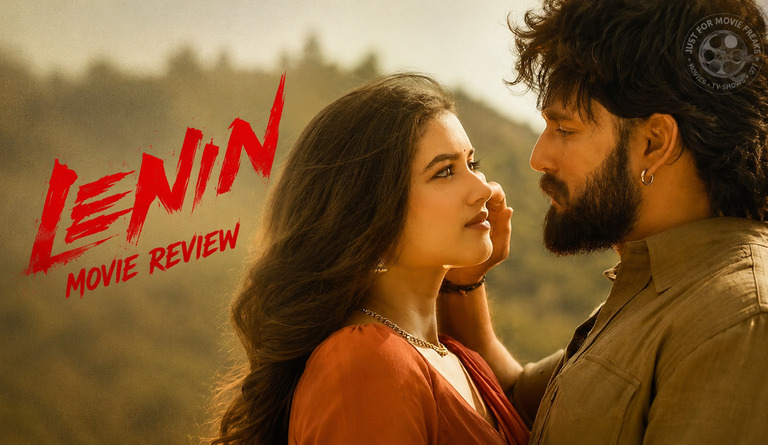
Lenin Review: An Enjoyable Commercial Entertainer!
There’s always a certain nostalgia attached to watching a full-fledged Telugu commercial entertainer. The larger-than-life hero, the village backdrop, the romance, the family drama, the action set pieces, and the emotional payoffs, these are ingredients many of us have grown up watching. The challenge today, however, is that audiences have seen these formulas countless times.
Related – “The Odyssey (2026)” Review: Nolan Conquers Another Blockbuster!
Simply repeating them is no longer enough. A filmmaker has to bring something fresh while staying rooted in the familiarity that makes the genre enjoyable. That’s exactly where Murali Kishor Abburu’s Lenin finds its biggest strength. It takes a well-known commercial template but executes it with enough freshness, unpredictability, and character-driven storytelling to make the journey worthwhile.
Set in the late 1970s in the Chittoor district, Lenin follows the life of an orphan who is adopted by the respected village leader Jayanthi and raised alongside her biological son. As Lenin grows into adulthood, he earns the love of the villagers and falls for Bharathi, but beneath the peaceful surface lies a web of political rivalries, hidden agendas, and long-buried secrets waiting to erupt. Against the backdrop of an eighteen-day village festival inspired by the Kurukshetra war from the Mahabharata, the story gradually transforms from a familiar rural drama into a gripping tale of betrayal, revenge, and justice.
The first forty minutes admittedly feel quite familiar. We meet the righteous protagonist, witness his kindness toward the villagers, watch the romantic track unfold, and see several situations that resemble countless Telugu films that came before it. During this stretch, the film doesn’t appear particularly interested in breaking new ground. But just when it feels like everything is moving along a predictable path, the narrative shifts around the pre-interval, and that’s when Lenin begins to reveal what it has actually been building toward.
One of the aspects I appreciated most was how the film handles its large ensemble of characters. Early on, we’re introduced to numerous supporting players, and I initially wondered whether they would simply fade into the background, existing only to populate the village. Surprisingly, almost every important character eventually finds a purpose within the larger narrative.
While I do feel that a few of them could have benefited from stronger establishment in the opening portions, the screenplay does a commendable job of weaving them into the central conflict as the story progresses. Their motivations, loyalties, and decisions all contribute meaningfully to the unfolding drama instead of feeling like unnecessary additions and gimmicks.
Another element that stands out is the way the film incorporates its cultural backdrop. The eighteen-day village festival, inspired by the eighteen-day Kurukshetra war, isn’t merely used as a decorative setting. It becomes an integral part of the storytelling, adding thematic weight to the conflicts unfolding within the village. The parallels between tradition, loyalty, betrayal, and the moral complexities of the Mahabharata subtly enhance the narrative without overwhelming it, creating deeper emotional and philosophical resonance.
The second half is where Lenin truly comes alive. The screenplay becomes considerably more engaging, revealing twists at the right moments while constantly shifting audience expectations. What makes these portions particularly enjoyable is that almost every major character operates within shades of grey, making every decision feel increasingly unpredictable and emotionally grounded throughout.
Apart from the central hero and heroine, very few people can be categorized as purely good or evil. Each character has personal motivations, ambitions, and emotional baggage that influence their choices. Because of this, the story rarely feels predictable. You’re constantly left wondering who will betray whom, whose intentions are genuine, and how the various threads will eventually come together. That unpredictability keeps the momentum alive throughout the latter half.
The commercial aspects are equally satisfying. The action sequences are staged with enough energy to deliver the mass appeal audiences expect, while never completely overshadowing the emotional narrative. S. Thaman’s pulsating background score elevates many of these moments, adding intensity to both the action blocks and the emotional confrontations, making several scenes linger much longer.
Performance-wise, the film is consistently strong across the board. Akhil Akkineni delivers what is comfortably his career-best performance. More importantly, he feels convincing as Lenin. His command over the regional slang, body language, and overall screen presence helps him disappear into the character rather than simply playing another commercial hero. While he handles the action sequences confidently, it’s during the emotional scenes, particularly those in the climax, that he leaves the strongest impression, showcasing a maturity that hasn’t always been visible in his earlier work.
Bhagyashri Borse, after proving her acting capabilities in Kaantha, once again delivers an impressive performance here. She brings warmth, confidence, and emotional depth to Bharathi, ensuring the character remains significant to the overall narrative instead of becoming just another romantic interest. Her chemistry with Akhil works naturally, and she contributes meaningfully to several key emotional moments. Sivaji Sontineni is another major highlight. His character is written with clear motivations and layered intentions, allowing him to command attention whenever he appears. As expected, Sivaji delivers with remarkable conviction.
Overall, Lenin succeeds because it understands the essence of a mainstream Telugu commercial entertainer while refusing to rely solely on nostalgia. Yes, it begins on familiar ground, but gradually evolves into a more engaging and unpredictable narrative driven by layered characters, effective twists, strong emotional payoffs, and a culturally rich backdrop. While a handful of supporting characters could have been fleshed out more during the opening portions, the film more than compensates with a gripping second half, solid performances, and confident storytelling. Murali Kishor Abburu delivers a mass entertainer that respects genre conventions while finding fresh ways to present them, making Lenin an enjoyable blend of mass appeal, emotion, and engaging drama.
‘Lenin’ Rating – 3.25/5

- Short Film Review: An Old Scar – Heartfelt and Emotional! - October 7, 2026
- Short Film Review: Hog Heaven: The Pigz Brotherz Story — Bittersweet! - October 7, 2026
- Short Film Review: Memories From Ground Zero Review – Memories That Haunt! - October 6, 2026