
Ghostlight (2024) Review: Emotion Through Separation!
Ghostlight, written and directed by Tatyana Yassukovich, is an experimental ensemble drama that uses the pandemic era not simply as a backdrop, but as the emotional core of its storytelling. Rather than following a conventional narrative structure with a clear beginning, conflict, and resolution, the film drifts through fragments of lives, conversations, Zoom calls, rehearsals, and isolated moments.
Related – “The Family Recipe” Review: Charming & Heartfelt Dramedy!
It functions less like a straightforward movie and more like a time capsule of what many people experienced during the early stages of COVID lockdowns and quarantines—especially artists and performers whose lives revolved around human interaction, stage plays and suddenly found themselves confined within four walls.
One thing the film establishes very effectively right from the beginning is the overwhelming feeling of isolation. The story starts during the early months of 2020 and gradually moves deeper into the pandemic period, and that timeline works because you can slowly feel the emotional shift taking place. What initially feels like a temporary inconvenience gradually turns into exhaustion, loneliness, and emotional fatigue. You can almost see the characters changing as the months pass. People begin losing pieces of themselves, routines become repetitive, uncertainty becomes normal, and mental health slowly begins deteriorating.
What I appreciated is that Ghostlight doesn’t sensationalize these feelings. Instead, it quietly observes them. It becomes a surprisingly deep exploration of that period and the psychological effects it had on ordinary people, especially individuals whose identities were deeply tied to creativity and performance.
View this post on Instagram
The film also benefits from its ensemble cast because every character is dealing with a different struggle. Everyone is carrying their own emotional weight while trying to survive mentally through a period where the future itself felt uncertain.
I particularly liked Francesca Faridany in her performances. Deirdre stands out because she represents a type of personality many of us probably encountered during the pandemic—the person with unusual beliefs, conspiracy-like ideas, frustrations directed toward humanity, and strong opinions on everything happening around them. The performance never turns her into a caricature; instead, it makes her feel like someone who could genuinely exist.
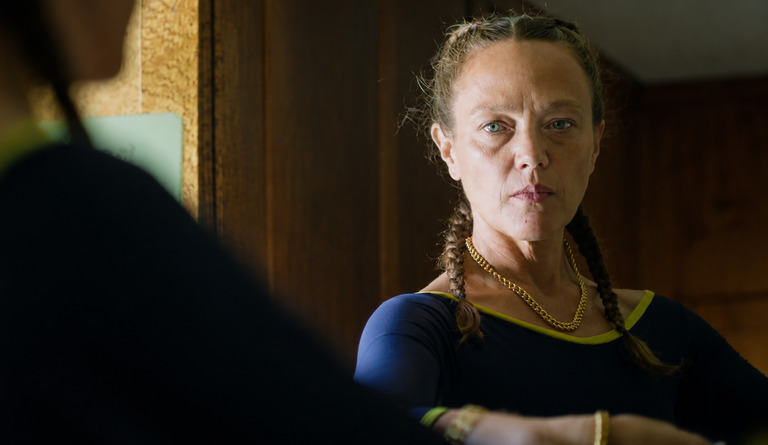
Francesca Faridany also deserves credit for handling two distinct characters because the contrast between those personalities becomes noticeable. Natasha, the strict and perfectionist acting coach, feels emotionally restrained in a very different way. Beneath her controlled and disciplined exterior, there’s a clear sense that she is carrying personal grief and emotional exhaustion of her own. Balancing two separate personalities without making them blur together is not easy, and she handles both convincingly.
Another storyline that emotionally worked for me involved Tito and Jorge, played by Eduardo Machado and Joe Quintero. Amid all the uncertainty surrounding everyone else, their relationship becomes one of the warmer emotional threads running through the film. While the world around them is changing and anxiety continues building, they try to maintain optimism and emotional connection. Their scenes become some of the more touching moments, especially toward the end where the dialogue carries genuine emotional weight.
View this post on Instagram
I also liked Maisie, Alice, and Sasha, all of whom deal with very different emotional battles. Maisie struggles with losing the spaces where she expresses herself as an artist. Alice deals with financial pressures and emotional loneliness, while Sasha’s storyline touches on deeper psychological struggles and personal fears. Each of them represents different aspects of what isolation looked like during that time.
Across the board, the performances are easily the film’s strongest element. Since Ghostlight relies heavily on conversations and emotional interactions rather than plot-driven momentum, the actors are carrying a lot of responsibility. Thankfully, they all deliver performances that feel natural and emotionally believable.
Technically, the film also deserves appreciation. The cinematography by Jen Schneider and Heather Treston works really well within the restrictions of the film’s style. Since much of the story unfolds indoors through webcams, apartments, bedrooms, and digital spaces, the visual language itself becomes part of the storytelling. The natural lighting and confined spaces subtly reinforce the feeling of isolation and emotional distance between characters. The score by Jay Purdy also quietly strengthens the emotional tone of the film. Rather than overwhelming scenes, the music leans into softer dramatic textures that support the emotions already present.
Related – “A Night with Nathan” Review: Simple Yet Charming!
Overall, Ghostlight feels like a reflective portrait of a strange moment in recent history. It isn’t necessarily concerned with telling one big story; instead, it focuses on human experiences during a time when people were physically separated but emotionally searching for connection. Through isolation, uncertainty, grief, and creativity, the film quietly reminds us that even when the world temporarily stopped, people still kept searching for ways to feel seen and heard. You can now rent and stream ‘Ghostlight (2024)’ on Amazon, Google Play, Dish Anywhere and Vimeo, click on this link for all the details and check out the movie’s Instagram page for more updates.
‘Ghostlight (2024)’ Rating – 3.75/5

- Short Film Review: An Old Scar – Heartfelt and Emotional! - October 7, 2026
- Short Film Review: Hog Heaven: The Pigz Brotherz Story — Bittersweet! - October 7, 2026
- Short Film Review: Memories From Ground Zero Review – Memories That Haunt! - October 6, 2026




Pingback:The People in the Walls (2024) Review: Creepy Yet Effective! - Just for Movie Freaks