
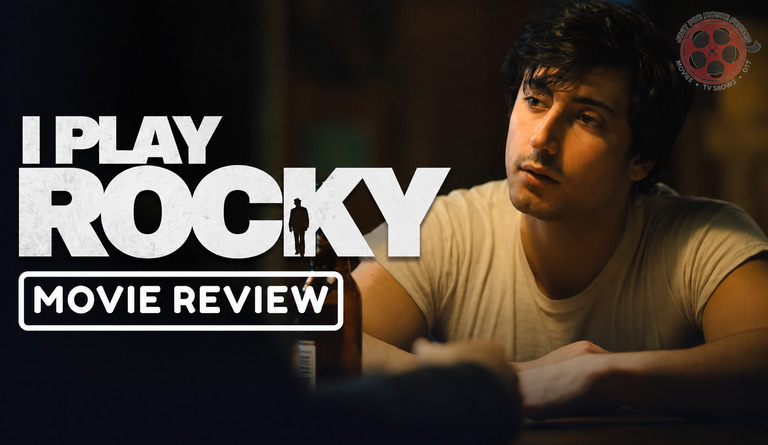
I Play Rocky Review: Engaging and Heartwarming!
You don’t necessarily have to be familiar with a filmmaker’s entire body of work to become interested in the story behind one of their most celebrated creations. Interestingly, I have never watched a single Rocky movie. I’ve seen the first Creed starring Michael B. Jordan, but that’s about as far as my familiarity with the franchise goes. So what made me interested in I Play Rocky? Over the last few movies I’ve watched in theatres, its trailer kept playing before the screenings. Somehow, it caught my attention, and I eventually decided to give it a shot. Having watched it, I can say that I had a good time discovering the story behind the making of a Hollywood classic.
Also Read – “Clayface” Movie Review: Unsettling and Skin-Crawling!
At its heart, I Play Rocky is a straightforward rags-to-riches story, following a struggling young Sylvester Stallone as he tries to make something of himself in Hollywood. It’s a familiar underdog narrative, not entirely different from the story of Rocky Balboa himself or several other films we’ve seen over the years. However, what makes this particular story interesting is Stallone’s unwavering belief in his own abilities and his determination to see his creative vision become reality. Even when Hollywood offers him substantial amounts of money to sell his screenplay, he refuses to give up his one non-negotiable condition: he wants to play the lead character himself. It’s a story about self-belief, and the willingness to risk financial security for something you genuinely believe in.
Peter Farrelly structures the narrative quite effectively, giving the story a natural progression through three distinct stages. The first act establishes Stallone’s difficult circumstances, including his struggles with homelessness, financial instability and his attempts to find opportunities as an actor. It gives us an understanding of just how desperate his situation is and how little he has going for him.
The second act shifts towards his creative journey, particularly the development of the Rocky screenplay with the support of his wife, Sasha Czack. We see how the idea takes shape and how Stallone gradually finds himself in a position where he must stand his ground against producers who have different ideas about casting the lead. Finally, the third act focuses on getting the film made, dealing with a shoestring budget, a tight production schedule and all the challenges that come with bringing an ambitious project to life.
What I particularly liked about this structure is how each stage contributes to the eventual payoff. The initial struggles establish the stakes, the screenplay negotiations provide the central conflict, and the production phase brings everything together. There are plenty of ingredients here for an inspirational and emotional drama, and the film makes good use of them. I initially wondered whether there would be enough material to sustain a feature-length movie, considering that the central premise is relatively simple. However, the storytelling remains engaging throughout, and I never really felt bored. There are some genuinely funny moments, alongside heartwarming interactions and emotional scenes that make Stallone’s journey enjoyable to watch.
The performances are another major strength. Anthony Ippolito is fantastic as Sylvester Stallone. From the accent and physical resemblance to the mannerisms and overall body language, he does a terrific job of recreating a young Stallone. He genuinely inhabits the character and brings the determination, vulnerability and ambition required for the role. AnnaSophia Robb is equally effective as Sasha Czack. She plays an important part in Stallone’s personal journey, serving as his partner, wife and biggest supporter. Robb brings warmth to the character, making their relationship an important emotional component of the narrative.
P.J. Byrne as Irwin Winkler and Toby Kebbell as Robert Chartoff also deserve appreciation. Their characters are particularly important to the story because they represent the producers willing to take a chance on a unknown actor with an unconventional demand. Both actors handle their respective roles well, and their interactions with Stallone provide some of the film’s most important dramatic moments.
If there is one area where I felt the film could have done more, it is the emotional depth. There is already a good amount of drama, particularly when Stallone faces financial uncertainty and has to decide whether to compromise his ambitions. However, I felt there was room for a few more emotionally powerful scenes. Certain relationships and personal struggles could have been explored further, giving the audience additional opportunities to connect with the characters. The film already has the foundation for these moments, and a little more attention to them could have elevated the overall dramatic impact.
Ultimately, I Play Rocky isn’t an extraordinary story or a particularly groundbreaking biographical drama, and I didn’t walk out of the theatre thinking I had watched something exceptional. But that doesn’t take away from the fact that I enjoyed the film. It’s an engaging and heartwarming account of a young man who refused to compromise on his ambitions, even when more financially rewarding option was right in front of him. Anthony Ippolito’s performance, and the film’s entertaining storytelling make the journey worthwhile.
‘I Play Rocky’ Rating – 3.5/5

- I Play Rocky Review: Engaging and Heartwarming! - November 23, 2026
- The Great Departure Review: Ambitious Yet Underwhelming - November 20, 2026
- The Midnight Ride of Jonathan Luna Review: Compelling and Informative! - November 19, 2026