
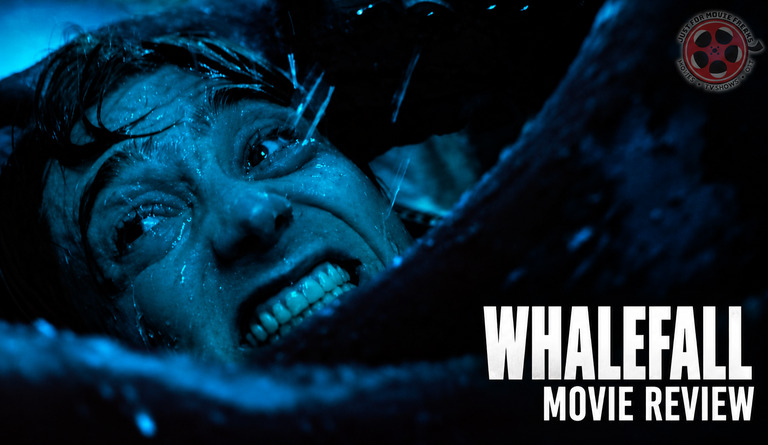
Whalefall Review: A Watchable Survival Thriller!
The idea of being trapped in the belly of a giant whale sounds like a nightmare, but it also makes for an intriguing survival thriller. Based on Daniel Kraus’s bestselling 2023 novel, Whalefall, directed by Brian Duffield, takes a familiar man-versus-creature premise and places its protagonist in an unusual predicament. As someone who is genuinely afraid of water, oceans, and beaches, this is exactly the kind of film I find fascinating from a safe distance. Put me anywhere near the ocean, though, and I’d probably panic! Fortunately, watching someone else battle the deep sea makes for a considerably more manageable experience.
Also Read – “The Social Reckoning” Review: A Timely Thought-Provoking Drama!
The film follows Jay Gardiner (Austin Abrams), a young man grieving the suicide of his terminally ill father, Mitt (Josh Brolin). Hoping to find his father’s remains and achieve some closure, Jay ventures into the ocean for a dangerous solo dive. However, an encounter between a giant squid and a massive sperm whale changes everything when Jay is accidentally swallowed by the enormous creature. With his oxygen supply running out and very little time to escape, he must rely on the diving and survival lessons his father taught him. As Jay fights to find a way out, the film also explores his complicated relationship with Mitt that continue to haunt him.
What initially drew me to Whalefall was its classic man-versus-creature setup. Being swallowed by a whale is certainly an unusual predicament, but the broader idea of a person fighting against an overwhelming force of nature feels familiar. Nevertheless, I was interested in seeing how the filmmakers would approach it. Thankfully, the movie remains watchable and engaging enough to keep you invested until the very end. One of its more interesting choices is that it essentially tells two stories: Jay’s struggle to survive and the complicated father-son relationship that unfolds through flashbacks. Surprisingly, I found myself enjoying the latter more.
The relationship between Jay and Mitt is rocky, uncomfortable, and often defined by verbal confrontations. Mitt is an authoritative father who constantly pressures Jay with his rigid approach to life rather than offering warmth or reassurance. Although there is love beneath his harsh exterior, years of resentment and unresolved conflict complicate their bond. Jay’s frustration feels understandable, and I genuinely enjoyed watching their dynamic develop throughout the film. Their scenes add emotional depth to Jay’s fight for survival, making it about more than simply escaping a dangerous situation and highlighting the importance of family bonds.
On the other hand, the survival storyline is a mixed bag. Before Jay is swallowed, the film is genuinely beautiful to look at. The underwater environments, the enormous sea creatures, and the action surrounding the whale and the giant squid make for some entertaining sequences. There is something inherently thrilling about watching a human being navigate an environment where he is completely outmatched. The ocean feels vast, mysterious, and dangerous, and I found these sequences among the most visually engaging parts of the movie.
However, once Jay finds himself trapped inside the whale, the pacing slows down considerably, particularly during the second act. There are certainly tense moments and close calls as he struggles against his surroundings and his dwindling oxygen supply. But there is only so much a film can do narratively and visually when its protagonist is confined to such a restricted space for an extended period. Eventually, the situation begins to feel repetitive, and the survival sequences don’t always maintain the same level of excitement as the underwater action that precedes them. The premise remains compelling, but the film struggles to sustain its momentum.
Technically, though, Whalefall has plenty going for it. The sound design and sound mixing are particularly effective, especially during the underwater sequences. Hearing the whale and the surrounding ocean in a theatre adds an immersive quality to the experience, making the environment feel enormous and threatening. Aaron Morton’s cinematography is another highlight. The deep-sea visuals make excellent use of teal lighting, creating an atmospheric underwater world that is beautiful without losing its sense of danger. The contrast between the expansive ocean and the claustrophobic interior of the whale also reinforces the two sides of Jay’s ordeal.
Austin Abrams carries much of the film on his shoulders, and he does a commendable job. He fits this kind of character well, much as he did in Resident Evil, where his screen presence felt suited to the material. Here, he handles both the physical demands of the survival storyline and the emotional weight of Jay’s relationship with his father. With so much of the film depending on his reactions and performance, Abrams manages to keep Jay’s struggle compelling even when the pacing falters. Josh Brolin is equally impressive as Mitt. His commanding presence and strict approach to life make him convincing as a difficult, sometimes downright unpleasant father.
Ultimately, Whalefall is an engaging survival thriller that finds its strongest emotional footing in the relationship between a troubled son and his difficult father. The underwater action, immersive sound design, atmospheric cinematography, and committed performances make it worth watching, while the confined survival sequences occasionally struggle to sustain the excitement. I was particularly surprised by how much more invested I became in the family drama than in the central battle for survival. Although the film loses some momentum once Jay is trapped inside the whale, it remains an effective enough combination of adventure and emotional drama.
‘Whalefall (2026)’ Rating – 3/5

- Whalefall Review: A Watchable Survival Thriller! - October 29, 2026
- The Bad Ones (2026) Review: Mystery, Madness, Reptilians! - October 28, 2026
- Short Film Review: My Name Is John – Impressive and Intriguing! - October 27, 2026