
Noblestone Review: An Impressively Confident Experiment!
There is something particularly exciting about watching young filmmakers discover what cinema can be when almost everything they traditionally have access to is taken away. Similar to Metecan Duren’s “Pretty”, Albert Goya’s Noblestone is the kind of project that makes you appreciate the sheer willingness to experiment. Completed when Goya was only 19, with his sister Lucia Goya-Betts as the sole performer, the film is an unusually stripped-down piece of filmmaking: two characters, two houses, an abundance of conversations, and practically nothing else. On paper, that sounds restrictive. In execution, it becomes the film’s entire identity.
Related – “Mala” Movie Review: A Decent Ancient Tantric Film!
The writing is where Goya takes the biggest gamble. There is no elaborate ensemble, no constant movement between locations, and no conventional plot machinery pushing the story forward every few minutes. Instead, the film slowly builds a psychological relationship between an unnamed artist and her eccentric live-in maid, Karen. The artist is wealthy enough to own two homes and comfortable enough to dedicate her life to her art. But underneath that privilege is an almost childlike desire to exist in a world where she is constantly admired, protected and reassured. She doesn’t particularly want criticism; she wants validation.
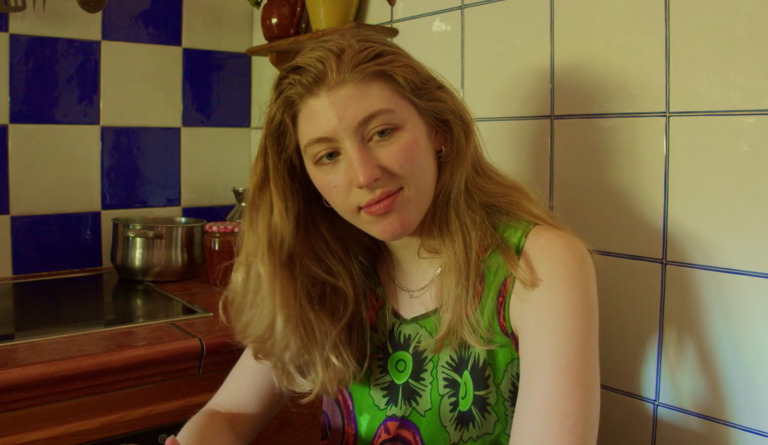
Then comes Karen. Karen is strange enough to feel almost extraterrestrial. The way she speaks, moves and behaves is consistently unusual, sometimes creepy and often completely absurd. Her appearance adds another layer to that unsettling personality. Yet there is something fascinating about watching the artist become increasingly drawn toward her. Karen gives her exactly what she wants to hear, particularly when it comes to her art, and that attention gradually creates a strange attachment between them.
What makes the screenplay interesting is that the actual story develops almost invisibly underneath their conversations. They talk about themselves, art, morality and seemingly random subjects, but every interaction is quietly building their relationship. Karen becomes increasingly fascinated by her employer, while the artist becomes fascinated by Karen’s eccentricity. The first two acts are essentially about constructing this unusual bond; the final act is about what happens when the relationship begins to crack.

That is a risky way to structure a film. When your entire movie depends on two people talking, the writing has nowhere to hide. There has to be enough personality, subtext and curiosity in those conversations to keep the viewers engaged. Goya largely pulls it off because the characters themselves become the mystery. You aren’t simply waiting for the next plot point; you’re watching these two increasingly strange people trying to understand, manipulate and perhaps even possess one another.
And then there is Lucia Goya-Betts, carrying the entire film by playing both characters. As the artist, she adopts a restrained performance built around minimal expressions, controlled body language and an almost deliberately detached emotional quality. Karen requires the exact opposite approach. Her vocals, physicality, mannerisms and unpredictable behavior are amplified considerably, and Goya-Betts commits fully to the character’s craziness.
Visually, Albert Goya uses color almost as another storytelling tool. The interiors are frequently drenched in highly saturated, warm yellow tones during the day, while nighttime sequences shift toward cooler blue shades. Exterior imagery introduces lush greens and expansive blue skies, giving the film a strikingly colorful appearance despite its psychological subject matter.
The camera placement is equally inventive. Goya frequently experiments with unusual framing, and the positioning of his characters within the frame, finding ways to make relatively simple environments visually engaging. Because there are so few locations and performers, the camera has to continually discover new ways of observing them, and that experimentation pays off.

There is an intentional sense of composition in the imagery that makes the film feel much larger than its resources would suggest. The background score, also composed by Goya, complements this approach nicely. Different scenes receive different musical textures, helping underline shifts in mood without overwhelming the dialogue-driven storytelling.
My biggest reservation is also the film’s most obvious characteristic: Noblestone is slow. Very slow. There are extended pieces of B-roll, deliberately prolonged moments and scenes that take their time even when the narrative could theoretically move faster. This is clearly an intentional stylistic decision rather than an accident, but it requires considerable patience from the viewer. I was willing to go along with it this time, although if you asked me to sit through another film with this exact rhythm tomorrow, I might have second thoughts.
For a no-budget film made by a 19-year-old filmmaker with essentially one performer, Noblestone is an impressively confident experiment. It won’t work for everyone, particularly viewers looking for conventional pacing or a more immediate narrative, but its visual ambition, unusual character construction and commitment to dialogue-driven psychological storytelling make it difficult to dismiss. Most importantly, it feels like the work of someone actively searching for his own voice, and that, perhaps more than anything else, is what makes Noblestone worth watching.
‘Noblestone (2026)’ Rating – 3.75/5

- I’d Rather Be Turned Into Cat Food Review: Genuinely Distinctive! - September 30, 2026
- Music Video Review: All Over Again (2026) – Heartfelt! - September 29, 2026
- Short Film Review: Is This the Bed We Lie In? (2025) – Deeply Intimate! - September 29, 2026




Pingback:Lady Parts (2026) Review: Heartfelt & Hilarious! - Just for Movie Freaks