
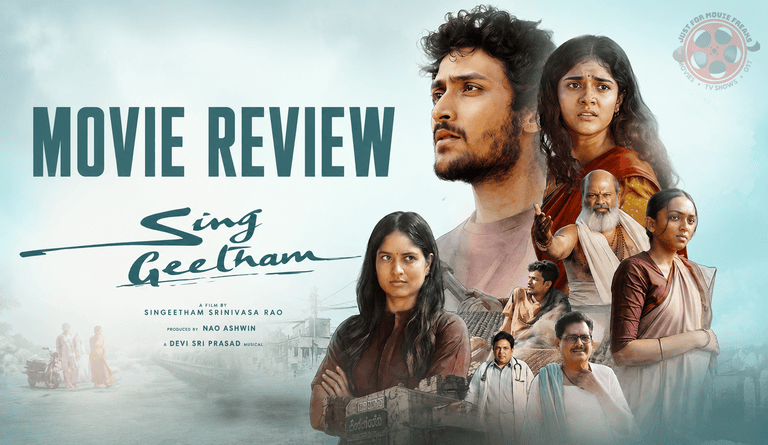
Sing Geetham Review: Fascinating & Courageous!
There are very few filmmakers who continue to experiment after decades in the industry. There are even fewer who continue chasing completely new ideas in their 90s. That is what makes Sing Geetham such a fascinating film before you even begin discussing its story. At 94 years old, legendary filmmaker Singeetham Srinivasa Rao has taken a concept that most filmmakers would never dare attempt and brought it to the screen. A film where nearly 90% of the dialogue is sung rather than spoken sounds like an impossible challenge on paper, yet Rao’s willingness to venture into unexplored territory is exactly what has defined his remarkable career.
Related: Best Telugu Movies on Netflix You Shouldn’t Miss Watching!
The story of Sing Geetham takes place in the mysterious village of Kuberapuram, a place transformed by a divine curse after environmental destruction caused by corporate greed. When an outsider named Prathap arrives in search of prosperity and opportunity, he finds himself caught in a bizarre world where people communicate through song rather than speech. As he slowly uncovers the secrets of the village, he becomes entangled in a larger conflict involving environmental destruction, greed, community, tradition, and the fight to preserve nature against exploitative mining interests.
Let’s begin with the positives, the initial setup of the film works surprisingly well. The first twenty-five minutes do a good job establishing the village, its unusual atmosphere, the mystery surrounding the gold mine, and the overall state of the community. There is enough intrigue built into the narrative to keep you invested before the film fully commits to its musical structure.
The real test arrives when the curse takes effect and the singing begins. Starting with the “Emaindhi Emaindhi” sequence, the film introduces audiences to a world where every conversation, argument, emotion, and reaction must be expressed through melody. I thought the initial confusion and chaos surrounding this phenomenon were handled quite effectively. The film spends much of the first half exploring how different people within the village react to and even benefit from this bizarre circumstance. Additional layers are gradually added to the curse, making the concept more interesting than simply people singing their dialogue.
That said, this is undeniably a film that demands patience and an open mind from its audience. The singing takes time to get used to. Once the film fully embraces the concept, it rarely steps away from it. If viewers are not willing to accept that nearly the entire movie will function this way, the experience may become challenging. I could even sense this reaction from the audience around me. This gives Sing Geetham a very niche appeal.
I also think the first half faces an additional challenge because many of the central performers are relatively new faces. Audiences are simultaneously being asked to accept an unconventional storytelling style while also connecting with unfamiliar actors. It’s a difficult balancing act and one that occasionally makes the opening portions feel slightly uneven.
The second half, however, is where the film truly finds its footing. A major flashback sequence provides important context regarding the village’s history and explains how it reached its current state. More importantly, the film begins exploring its deeper themes. The conflict between environmental preservation and corporate greed becomes much clearer. Themes involving human behavior, unchecked ambition, materialism, community responsibility, climate concerns, cultural roots, and the consequences of valuing wealth over sustainability all become central to the narrative.
There is a lot packed into the latter portions of the film, and the emotionally driven climax brings these ideas together beautifully. In many ways, the finale feels like a classic bedtime story carrying an important moral lesson. It is heartfelt, sincere, and emotionally satisfying. The decision to keep the runtime around two hours and ten minutes also helps significantly. A concept this experimental could have easily become exhausting with a longer runtime, but the film generally knows when to move forward.
The backbone of the entire project, however, is undoubtedly Devi Sri Prasad. Without his contribution, a film like this simply does not work. Every line requires rhythm, melody, and emotional variation. Every conversation needs to feel natural despite being sung. Every emotional beat needs to land musically. That is an enormous challenge, and DSP rises to it impressively. The actual songs are highly enjoyable, the musical motifs remain easy on the ears, and the score carries the narrative remarkably well. Had the music failed, the entire experiment could have collapsed. Instead, it becomes the film’s greatest strength.
The performances are strong across the board. Ayaan does well as Prathap, portraying a character whose journey gradually transforms him from someone chasing prosperity into someone fighting for something larger than himself. Ahilya Bamroo deserves particular praise. Despite not being a native Telugu speaker, she handles the challenging dialogue and musical delivery admirably. While traces of her accent remain noticeable, her expressive performance, vulnerability, charm, and chemistry with Ayaan help overcome those limitations.
For me, though, Shalini Kondepudi emerges as the standout performer. Her character receives one of the more interesting arcs in the film, particularly through her relationship with her father and her evolution throughout the narrative. She possesses the intensity needed for the role while also bringing emotional depth during the film’s most dramatic moments. Her performance remains memorable long after the credits roll.
Technically, the film is ambitious. The visual effects are used extensively and are generally handled well. The production design deserves recognition, especially considering how much of the world had to be constructed through elaborate sets and visual enhancements. I was less impressed by portions of the cinematography, particularly some of the night sequences, which occasionally lacked the visual richness found elsewhere in the film. Still, the overall technical package supports the film’s fantasy-driven storytelling effectively.
Ultimately, Sing Geetham is not a film that will work for everyone. Its all-sung format requires complete commitment from both the filmmakers and the audience. But even when it stumbles, there is something admirable about its ambition. More than anything, this film stands as a testament to Singeetham Srinivasa Rao’s relentless creativity. At an age when most people would simply be enjoying retirement, he chose to pursue a dream he had carried for decades and bring an entirely unique cinematic vision to life. That alone deserves immense respect. The fact that the experiment largely succeeds makes Sing Geetham one of the most fascinating and courageous Telugu films in recent years.
‘Sing Geetham’ Rating – 3.5/5

- Hear Me (2026) Review: An Atmospheric Horror! - October 15, 2026
- Heart of the Beast Review: Friendship Against All Odds! - October 15, 2026
- One Eye Open Review: An Enjoyable Supernatural Horror! - October 14, 2026