
On the Waterfront (1954) Review: The OG Rebel!
We have to begin with the meaning of DND. No, it’s not “Do Not Disturb.” In On the Waterfront (1954), it stands for “Deaf and Dumb.” A code. A warning. A way of life. You don’t say anything. You don’t hear anything. You don’t see anything. It’s as if the mafia took Gandhi’s three wise monkeys and twisted them into something cold and metallic. Silence isn’t wisdom here; it’s survival. “Keep your mouth shut,” they say, and beneath it lies something darker: stay alive.
Related – Best Thriller Movies on Netflix You Shouldn’t Miss!
The docks of Hoboken feel like a living creature, fog thick, ropes hanging like half-forgotten sins, and the faces of men who have learned to live with their heads slightly lowered. Every morning, the whistle blows like a commandment. And every night, another soul disappears into the river’s black mirror. Johnny Friendly rules this world with a grin sharp enough to cut through bone. He isn’t just a man; he’s an institution, a shadow the size of a city.
And all of it hangs on silence. “DND,” someone murmurs. It’s a mantra spoken out of fear. It’s the heartbeat of corruption. It’s the reason innocent men get pushed off rooftops while the city looks away. The brilliance of the film is how this code begins to crack — one man, one conscience, one spark. But before the spark, there is only darkness. A darkness thick enough to swallow truth whole.
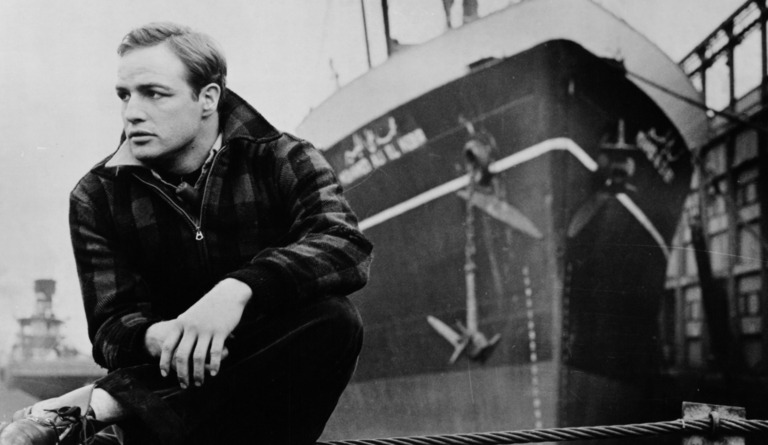
Terry Malloy, played by Marlon Brando in a performance that feels carved out of bruised flesh, lives by another kind of street scripture: “Do it to him before he does it to you.” You can almost hear him mutter it under his breath, not because he believes it, but because the world has made him believe he has no other choice. Once a prizefighter, now a hollowed-out errand boy, Terry is a man who has been used like a blunt instrument by people sharper than knives.
Brando moves like a wounded animal: tender, dangerous, confused. His voice, that famous mumble, feels like a language that exists only between him and his regrets. And the film knows it. Watch the way he stands, shoulders slumped, eyes carrying storms he doesn’t have the words to name. “I coulda been somebody,” he says later, in one of cinema’s most heart-shattering confessions. It isn’t just a line. It’s a lifetime spilling out.
His philosophy isn’t cruelty; it’s protection. The world hit him first, and he learned to hit back. But the magic of Brando’s performance is the slow-burning realization that a man can’t fight his way into a conscience. He has to listen to it. And listening — in this world of DND — is the bravest act and decision of it all.
Johnny Friendly, played with volcanic force by Lee J. Cobb, is the face of organized fear. Every crate, every shipment, every paycheck, all of it passes through his fingers like offerings to a corrupted god. “I’m standin’ over here,” he shouts in the bar, pounding his fist, “I’m standin’ here for what’s right!” But the irony is so thick you could slice it. Nothing about Johnny is right. Everything about him is control.
He speaks in threats disguised as friendship. He smiles with teeth sharpened by power. The union, meant to protect workers, has become his personal empire. Protection is a myth. Fairness is a joke. And the docks, soaked with sweat and fear, become the stage for his tyranny. The realism of these scenes is staggering, the cold morning air, the clanging of metal, the suspicious glances passed like contraband.
Here, every man learns to shrink himself. Here, loyalty is survival. Betrayal is death. And yet, the film never loses sight of beauty — the beauty of truth clawing its way out. Nothing about this world is exaggerated. Elia Kazan shows it as it is: grimy, suffocating, pulsing with the moral rot of unchecked power. But under that rot, something begins to stir. Something brave. Something human.
Indian audiences who grew up on Amitabh Bachchan’s “angry young man” era will feel a shock of recognition watching Marlon Brando. Long before Deewar or Zanjeer, there was this, a man who didn’t shout, who didn’t throw punches for glamour, who simply existed with a kind of broken fire. He slouched like rebellion itself. His silence held more anger than any scream. And his face carried the exhaustion of someone tired of being used.
Brando didn’t perform Terry Malloy, he became him. His pain wasn’t theatrical; it was lived-in. Raw. Heavy. “You don’t understand,” he whispers at one point, eyes lost somewhere years before that moment. And you believe him because Brando always spoke from the inside out, as if peeling off layers of himself. Watching him is like watching guilt take human form. Every gesture, every pause, every desperate inhale feels alive.
He gave us a new kind of masculinity — not heroic, not victorious, but painfully honest. He made vulnerability look like a revolution. And as Terry’s conscience grows louder, the film’s heartbeat quickens. You feel the tension rise, like a violin string pulled tighter and tighter. And suddenly, silence no longer feels like survival. It feels like betrayal.
The writing in On the Waterfront is extraordinarily poetic yet raw, like someone carved philosophy into stone with bare hands. Every line feels earned. Every scene lands with the weight of lived truth. It’s not simply a screenplay; it’s a moral symphony. The story begins quietly, almost shyly, then rises and rises until the final crescendo hits with devastating force.
There are no wasted moments. No decorative flourishes. Nothing that exists without purpose. You could take a pair of scissors to the film, but you’d only wound it. The dialogue often feels like whispered confessions rather than written lines. Even the silences speak — perhaps the loudest of all. And when Edie Doyle looks at Terry with trembling hope, you feel a shift.
A small one, but enough to change the entire rhythm of the film. This completeness, this sense that every frame breathes intention, is what makes the film timeless. It doesn’t rely on twists or spectacle. Its strength lies in truth. In the ache of conscience. In the courage of a man learning to stand upright in a crooked world.
There isn’t a dull beat in this film. On the Waterfront moves like a song, rhythm, resistance, redemption. You can predict what happens, but prediction doesn’t matter when the feeling is this immense. You stay for the courage that blooms in silence, for the small moments where humanity refuses to die.
When the credits roll, you understand why this film still echoes — across continents, across cultures, across generations. It’s not simply about corruption, unions, or organized crime. It’s about a single man discovering the cost of having a voice. “I’m glad what I done,” Terry says at the end, bruised, bloody, but standing.
Related – Best Thriller Movies on Amazon Prime Right Now!
And that standing — that painful, trembling standing — becomes a victory larger than any speech. Larger than the docks. Larger than the system. Because justice is a language everyone understands. No matter the dock. No matter the country. And sometimes, all it takes is one man, in one moment, refusing the code of silence. DND finally breaks. And when it breaks, the world breathes again.

- City Lights (1931) Review: The Sweetest Heartbreak Ever Filmed! - November 18, 2025
- On the Waterfront (1954) Review: The OG Rebel! - November 15, 2025



Pingback:City Lights - Just for Movie Freaks