
Baltimore Film Festival 2026 Review: “Junkie” – A Strong Character-Driven Drama!
Junkie, written and directed by William Means, is a dark comedy-drama that explores addiction, motherhood, and redemption through the eyes of a woman who seems incapable of getting out of her own way. Set against the backdrop of the rural American South, the film follows a flawed protagonist whose life is a constant cycle of bad decisions, broken promises, and desperate attempts to stay afloat.
While the subject matter is undeniably heavy, Means approaches it with a surprising amount of humor, humanity, and compassion, creating a film that is often chaotic but consistently engaging. The film’s impact was recognized at the Baltimore Film Festival 2026, where it won Best Film, while Means received Best Director honors and Rocky Shay earned Best Performance for a standout turn.
Baltimore Film Festival 2026 Review: “How To Hide It” – Funny & Charming!
The story follows Stevie Chapman, a meth-addicted woman who escapes court-ordered rehab and immediately returns to the lifestyle she supposedly left behind. Over the course of the next few days, Stevie races and cause chaos across small Southern towns trying to make enough money to pay off debts and leave town for good. Along the way she reconnects with old associates, finds herself in increasingly reckless situations, and attempts to repair the fractured relationship she has with her son, Liam. What begins as a frantic survival story gradually reveals itself to be something more emotional, focusing on family, accountability, and whether someone trapped in addiction can still find a path toward redemption.
The biggest strength of Junkie is undoubtedly its performances. Rocky Shay delivers an excellent lead performance as Stevie and completely carries the film on her shoulders. Stevie is not an easy character to like. She’s irresponsible, self-destructive, manipulative, disorganized, and frequently makes the wrong choice. Yet Shay manages to make her feel undeniably human. Beneath all the chaos and poor decisions is a woman who is clearly struggling against herself, and Shay captures that contradiction beautifully. There are moments where Stevie is frustrating, moments where she’s funny, and moments where she’s genuinely heartbreaking.
View this post on Instagram
One of the most effective aspects of the story is Stevie’s relationship with her son Liam. The film wisely avoids easy sentimentality here. Years of addiction and neglect cannot simply be erased through a handful of conversations, and the screenplay understands that. Their relationship remains rocky throughout the film, carrying years of resentment, disappointment, and emotional scars. Yet there is also an underlying sense of love between them that never completely disappears. Watching that relationship slowly evolve becomes one of the most satisfying parts of the movie, and the way their arc reaches its conclusion feels earned rather than forced.
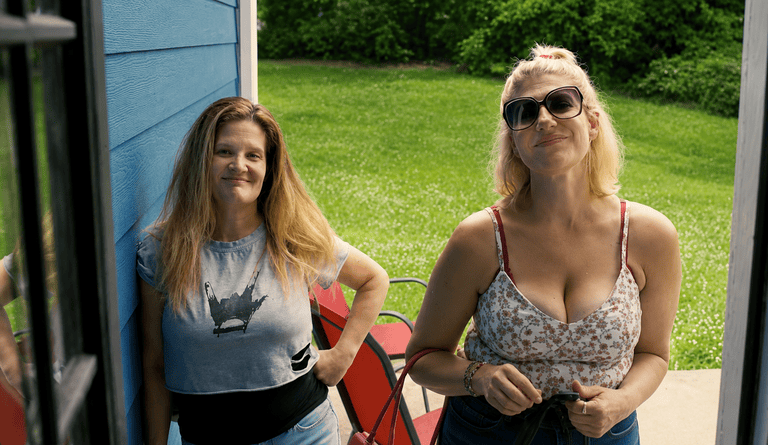
Jessica Lea Risco is also excellent as Sherry, Stevie’s longtime friend, rival, and fellow addict. Their relationship perfectly embodies the complicated nature of addiction, where loyalty and self-destruction often exist side by side. The chemistry between Shay and Risco works really well throughout the film, and the pair share several memorable scenes together. In particular, a major action sequence during the third act brings a different energy to the movie and provides one of its most entertaining stretches.
View this post on Instagram
Furthermore, I also appreciated the setting. The rural Southern backdrop gives Junkie a distinct identity that separates it from many addiction dramas that typically unfold in larger cities. The rundown locations, backroads, small-town atmosphere, and colorful supporting characters all contribute to the film’s authenticity. The Southern accents and regional culture help ground the story in a very specific place, making the world feel lived-in and believable. This ties directly into one of the film’s key themes: portraying communities that are often overlooked without romanticizing their struggles.
Story-wise, the film remains engaging for much of its runtime, but there are points where the pacing begins to drag slightly. A large portion of the narrative revolves around Stevie scrambling to make money, settle debts, and survive another day, and after a while some of those situations begin to feel a little repetitive. The film’s 105-minute runtime occasionally feels longer than necessary, and trimming ten to fifteen minutes may have tightened the overall pacing.
View this post on Instagram
Fortunately, the third act pulls everything together effectively. The emotional beats land well, the tension escalates naturally, and the film ultimately arrives at a conclusion that feels appropriate for Stevie’s journey. Rather than offering simplistic answers, it acknowledges the complexity of addiction while still allowing room for hope.
Overall, Junkie is a strong character-driven drama elevated by an outstanding central performance from Rocky Shay. William Means succeeds in humanizing a character who could have easily become a stereotype, presenting addiction as something messy, painful, frustrating, and deeply human. While the middle portion occasionally loses momentum, the compelling performances, distinctive Southern setting, and satisfying emotional payoff make Junkie a worthwhile watch. More than anything, it’s a reminder that people struggling with addiction are often far more complicated than the labels attached to them.

- The Social Reckoning Review: A Timely Thought-Provoking Drama! - October 21, 2026
- Hear Me (2026) Review: An Atmospheric Horror! - October 15, 2026
- Heart of the Beast Review: Friendship Against All Odds! - October 15, 2026



Pingback:The world of Wifer Calendez (2026) Review: A Distinct Indie Neo-Noir! - Just for Movie Freaks
Pingback:DWF:LA 2026 Review: “Rescued” - An Emotional & Uplifting Drama! | Just for Movie Freaks