
The Flesh People Review: Uncomfortable and Strangely Compelling!
I genuinely didn’t expect The Flesh People to make me feel this uncomfortable. At this point, I’ve watched enough body horror that very little manages to trigger that immediate “I need to look away” reaction anymore. But there is something about Keshav Srinivasan’s film that gets under your skin differently. Maybe it’s the characters, maybe it’s the grimy apartment they are trapped inside, or maybe it’s the way the increasingly disturbing situations become normalized by Ricky and Geraldine. Whatever the combination is, the film kept me feeling uneasy throughout its runtime, and that alone made it stand out to me.
Related – “Do Us Part” Movie Review: Hilarious, Heartfelt, Engaging!
The story works almost like a slow poison. One bad decision leads to another, which leads to something even worse, and before you realize it, Ricky and Geraldine have descended much further than where they started. Ricky is a medical school dropout, while Geraldine is a failed stage actress, and both are struggling to function within a society that doesn’t seem particularly interested in helping them. They are also dealing with drug addiction, financial desperation and an overwhelming sense of failure. What initially brings them together gradually becomes a bizarre partnership built around increasingly disturbing ways of making money.
What I liked about the screenplay is that it doesn’t suddenly transform these characters into monsters. Their descent happens incrementally. One questionable decision makes the next one easier, and eventually the increasingly macabre nature of what they are doing becomes almost normalized within their world. There is an interesting moral conversation running underneath all of this about how far someone can go when survival becomes the priority. Ricky and Geraldine repeatedly find themselves confronting questions about morality, existence and whether they even deserve to participate in the world around them.
That connects strongly with the film’s themes of modern anxiety, desperation and unfettered capitalism. These aren’t people chasing wealth because they want luxury; they are desperately trying to find a way to survive, make money and become functional members of society. But their methods become so grotesque that their original motivations almost disappear beneath the madness. Eventually, there is something disturbingly satisfying about the work they are doing for them, and the complete lack of regret they display makes their transformation even more unsettling. Keshav Srinivasan deserves credit for allowing that relationship and descent to develop gradually rather than rushing toward the most extreme material.
But the writing alone wouldn’t have made the film this uncomfortable. The world surrounding these characters is equally important, and The Flesh People builds an appropriately grimy one. The body horror is genuinely nasty. There is a rawness to the practical effects that makes the various surgical procedures, injuries and other grotesque imagery feel much more tangible than polished digital effects might have. Beatrice Sniper’s SFX work deserves considerable credit here. Some of these sequences are genuinely difficult to watch, not simply because they are graphic, but because the film gives them enough physical detail to make you imagine what everything must feel like. There were definitely moments where looking away felt like the better option.
The sound design by Nick Long plays an equally important role in making those visuals work. The squelches, cuts, impacts and other uncomfortable textures aren’t simply background noise; they become part of the physicality of the horror. The soundscape gives the gruesome imagery additional weight, making moments feel almost tactile.
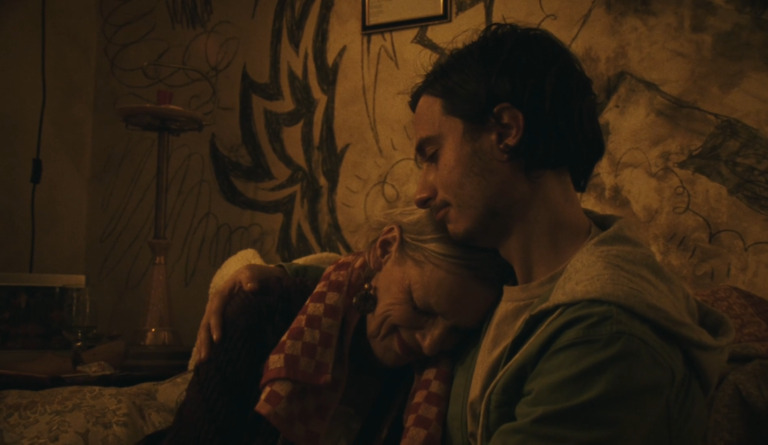
Then there is the apartment itself, which becomes almost another character. Emmet Luciano’s cinematography does an excellent job turning this confined space into something increasingly oppressive. The warm amber, ochre and brown tones, combined with low-key chiaroscuro lighting and a distinctly tungsten-heavy look, create a grimy visual texture. There is very little visual freshness in the environment, and that is exactly the point.
The frames feel heavy, enclosed and slightly dirty, reinforcing the psychological state of the characters. Yulanda Yo-Rong’s production design complements that beautifully. The rundown, cluttered and unkempt interiors look exactly like the kind of environment where these characters could exist and carry out the disturbing schemes they get themselves into. Even the surrounding locations contribute to that uneasy atmosphere. Nothing feels polished or comforting. The movie constantly gives you the sensation that you shouldn’t be there.
Vova Faust’s score is another interesting component. Rather than simply hammering with conventional horror music, it sometimes has an almost theatrical quality to it, which suits the film’s strange personality. It creates the impression of watching some grotesque stage performance unfolding in this tiny, miserable space, further blurring the line between the absurd and the horrifying.
And then there are the performances, which are crucial because without convincing characters, all of this could have easily become an extended exercise in shock value. Jorge Carrión Álvarez and Louise Heller make Ricky and Geraldine’s relationship surprisingly compelling. Initially, there is an awkwardness between them, particularly with Ricky trying to figure out how to match Geraldine’s sheer eccentricity. But as their partnership develops, the two actors gradually synchronize their energies.
Heller embraces Geraldine’s bizarre personality without making her feel like a caricature, while Álvarez gives Ricky a more restrained counterbalance. Together, they move convincingly through desperation, ruthlessness, delusion, absurdity and even black comedy. Their chemistry is strange, uncomfortable and, at times, genuinely funny, which is exactly what the film needs.
Related – “We Want the Virus” Movie Review: Lighthearted and Amusing!
Ultimately, The Flesh People succeeds because the horror isn’t confined to the gore. The real discomfort comes from watching two desperate people gradually normalize the unimaginable. Srinivasan combines character-driven writing, grotesque body horror, claustrophobic visuals and pitch-black comedy to create something that feels grimy, uncomfortable and strangely compelling.
This is absolutely not going to be for everyone. But if you’re willing to embrace its bizarre world, its grimy atmosphere and its unapologetically grotesque sense of humor, The Flesh People delivers a body-horror experience that genuinely gets under your skin. And for someone who rarely feels squeamish watching this genre anymore, that alone makes it stand out. Get more information about screening tickets and updates for ‘The Flesh People’ by visiting their website, and follow the movie on Instagram for further updates.
‘The Flesh People (2026)’ Rating – 4/5

- Hear Me (2026) Review: An Atmospheric Horror! - October 15, 2026
- Heart of the Beast Review: Friendship Against All Odds! - October 15, 2026
- One Eye Open Review: An Enjoyable Supernatural Horror! - October 14, 2026



Pingback:Designed by Preeti (2026) Review: A Warm, Feel-Good Story! - Just for Movie Freaks
Pingback:Mirror (2026) Review: An Intriguing Twin Deception! - Just for Movie Freaks