
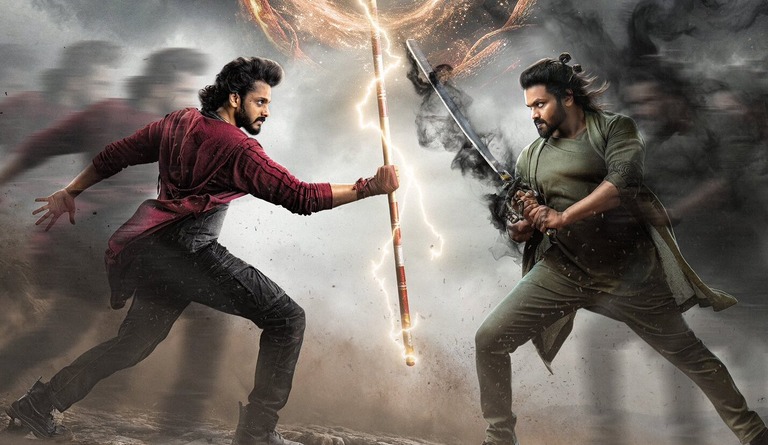
Mirai Review: Dreams and Delivers Big!
Karthik Gattamneni’s Mirai arrives as one of the most ambitious Telugu films in recent times, blending myth, fantasy, and futuristic spectacle into a singular cinematic vision. Written and directed by Gattamneni, the film brings together an ensemble cast that includes Teja Sajja, Manchu Manoj, Ritika Nayak, Shriya Saran, Jagapathi Babu, and Jayaram. The movie promises audiences a sweeping adventure that not only draws from India’s rich mythological roots but also imagines a world of high-stakes battles, adventures, and celestial power struggles.
Related – “The Long Walk” Movie Review: Gritty and Moving!
At the heart of Mirai lies the journey of Vedha (Teja Sajja), a street hustler, entrusted with the monumental task of safeguarding the nine sacred scriptures. These scriptures, imbued with divine energy, hold the potential to elevate mortals to the status of gods. However, lurking in the shadows is Mahabir Lama (Manchu Manoj), who hungers for the scriptures’ power to bend the world into his vision of darkness. The remainder of the story unfolds across mythological terrains, weaving together prophecy, courage, and destiny as Vedha and his allies tries to confront their enemies.
One of the most striking aspects of Mirai is its visuals. For a film made on a modest budget, it achieves a scale that feels expansive and grand, often rivaling big-studio productions. The cinematography—handled by Gattamneni himself—stands out as a masterstroke. Being both the director and director of photography, he uses his dual expertise to deliver an immersive visual treat. What’s more, the decision to shoot in physical locations rather than relying entirely on studio setups pays off enormously.
From the breathtaking backdrops of the Himalayas to the varied landscapes where Vedha’s journey unfolds, the environments feel organic and lived-in. These authentic locations, seamlessly blended with carefully executed VFX, create a believable mythological-futuristic world. The film dares to aim big, dream bigger, and deliver a canvas that constantly feels larger than its budget might suggest. This visual richness elevates the entire experience, allowing viewers to immerse themselves in the grandeur of the storytelling without being distracted by limitations.
When it comes to the narrative, Mirai plays it safe but keeps things engaging. The story itself is interesting, though it largely follows the familiar adventure movie template of good versus evil. That said, it never felt dull. There are enough dramatic elevations, thrilling set pieces, and even doses of humor sprinkled in to keep the journey entertaining throughout. The lighthearted comedy bits, in particular, were a welcome addition, balancing the intensity of the central conflict.
Still, one can’t help but feel that the story could have carried more weight and emotional impact. This is perhaps where Gattamneni’s relative inexperience as a storyteller shows—his vision is undeniably ambitious, but the narrative could have been sharpened to leave a stronger impression.
The action sequences, on the other hand, deserve genuine appreciation. Rather than drowning the film in CGI, the makers emphasize physical combat, which lends authenticity to the battles. One standout moment is the inventive fight sequence involving musical instruments, which is not only captivating but also aurally distinct. This creativity extends into the sound design where it becomes a driving force.
Furthermore, GowraHari’s background score infuses each sequence with energy and gravitas, and his willingness to experiment with different genres pays off. For example, the electronic score accompanying Tanja Keller’s character is strikingly fresh and adds a unique flavor to the film’s overall soundscape.
As for performances, the cast puts in commendable effort. Teja Sajja, Manchu Manoj, and Jagapathi Babu carry the weight of the dialogue-heavy script with ease, delivering their lines with conviction. Their presence helps anchor the story. However, Ritika Nayak and Shriya Saran, despite giving their best, struggle in parts—especially in moments where their lip sync does not quite match the pure Telugu dialogue. This mismatch creates a slight disconnect, pulling the audience out of otherwise engaging scenes. It’s here that the director’s choices falter again, revealing that tighter direction and dubbing supervision could have polished the performances further.
In the end, Mirai emerges as an ambitious and visually stunning film that dares to dream big despite its modest budget. While the story treads familiar ground and the execution reveals some rookie slips, the movie never loses its sense of adventure. Karthik Gattamneni may not have perfected his craft yet, but he proves he has the vision and courage to push boundaries. Mirai is a promising step in that direction—a film worth experiencing on the big screen for its scale and spectacle.
‘Mirai’ Rating – 3.25/5

- Air Shift Review: Light, Genre-Inflected Entertainment! - March 2, 2026
- All Saints Day (2025) Review: A Compelling Performance-Driven Drama! - February 27, 2026
- My Only Friend’s a Corpse Review: A Charming & Deliberately Campy Film! - February 24, 2026




Pingback:Kishkindhapuri (2025) Review: A Fantastic Audio-Visual Experience! - Just for Movie Freaks
Pingback:Little Hearts (2025) Review: Predictable & Unfunny! - JFMF
Pingback:They Call Him OG (2025) Review: Pawan Kalyan's ఊచకోత! - Just for Movie Freaks