
I Know Exactly How You Die Review: Intellectually Ambitious!
I Know Exactly How You Die operates within the psychological horror and slasher subgenre while incorporating strong metafictional undertones that examine the power of storytelling itself. The film follows a narrative that blurs the boundaries between creative imagination and tangible reality, positioning itself as a character-driven horror piece rather than a conventional body-count thriller. Set largely within the isolated geography of a mountain motel, the film uses spatial confinement as a narrative tool, allowing tension, paranoia, and psychological deterioration to gradually intensify.
Related – “Send Help” (2026) Review: A Deceptively Layered Film!
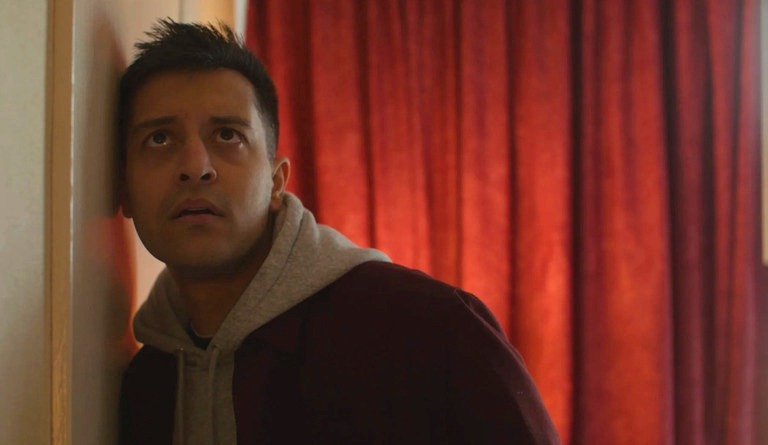
The story centers on Rian Burman, a financially struggling horror novelist battling personal heartbreak and creative stagnation. Retreating to a remote motel to meet a looming deadline, Rian begins writing a slasher narrative about Katie, a drug counselor attempting to escape a relentless stalker named Hector. As Rian progresses with his manuscript, unsettling coincidences begin manifesting around him, eventually confirming that Katie exists as a real individual hiding at the same motel. When violent incidents begin unfolding exactly as Rian writes them, he realizes that his fiction is dictating reality. As paranoia escalates, Rian attempts to manipulate his manuscript to prevent Katie’s fate, only to discover that his revisions generate increasingly catastrophic consequences.
Before diving into the story, screenplay mechanics, and writing complexities, it is important to highlight the I Know Exactly How You Die’s technical accomplishments. For an indie production, the film demonstrates exceptional visual discipline. Cinematographer Michael Kohlbrenner constructs a carefully orchestrated visual palette using controlled lighting gradients, precise framing symmetry, and calculated zoom-in techniques that organically manufacture suspense. The camera language enhances psychological tension rather than relying on over-stylized genre clichés, which is often a common pitfall in indie horror. The production design complements the cinematography, creating an immersive spatial atmosphere that reinforces isolation and unease. Additionally, the gore sequences and special effects are executed with commendable realism.
View this post on Instagram
The film also relies heavily on performance-driven storytelling, and both leads deliver committed portrayals. Rushabh Patel crafts a nuanced performance as Rian, embodying a character trapped in emotional, financial, and existential crisis. Patel effectively conveys Rian’s psychological fragmentation, transitioning from creative frustration and romantic despair into overwhelming confusion as his fictional world manifests into reality. His portrayal captures the vulnerability of a man attempting to regain control over a narrative that is rapidly consuming him.
Opposite him, Stephanie Gomes Hogan delivers a performance grounded in emotional credibility. From her initial appearance, she communicates fear, anxiety, and resilience through expressive micro-expressions and controlled physical tension. Her character arc reflects a gradual emotional evolution, balancing vulnerability with survival-driven determination, making her a compelling emotional anchor within the film’s metafictional chaos.
However, the film’s most ambitious element—its layered screenplay written by Mike Corey—also becomes its most polarizing. The narrative’s oscillation between reality and fiction creates a compelling psychological framework that sustains intrigue and conceptual originality. Yet, as the dual realities progressively merge, the narrative structure becomes convoluted. This complexity occasionally disrupts emotional engagement, making it difficult to fully invest in the protagonists’ psychological trajectories. Furthermore, the serial killer antagonist, despite being narratively significant, lacks sustained menace. The screenplay’s heavy focus on metafictional experimentation inadvertently diminishes the visceral intensity typically expected from slasher horror, reducing the overall impact of suspense and terror.
Related: Sundance 2026 Review: “Big Girls Don’t Cry” – Emotionally Grounded!
In conclusion, I Know Exactly How You Die is an intellectually ambitious independent horror film that excels in technical craftsmanship, atmospheric visual storytelling, and committed lead performances. While its layered narrative occasionally sacrifices emotional clarity and sustained horror tension, the film succeeds as a bold exploration of creative authorship, psychological vulnerability, and the dangerous intersection between imagination and reality.
‘I Know Exactly How You Die’ Rating – 3.5/5

- Short Film Review: An Old Scar – Heartfelt and Emotional! - October 7, 2026
- Short Film Review: Hog Heaven: The Pigz Brotherz Story — Bittersweet! - October 7, 2026
- Short Film Review: Memories From Ground Zero Review – Memories That Haunt! - October 6, 2026