
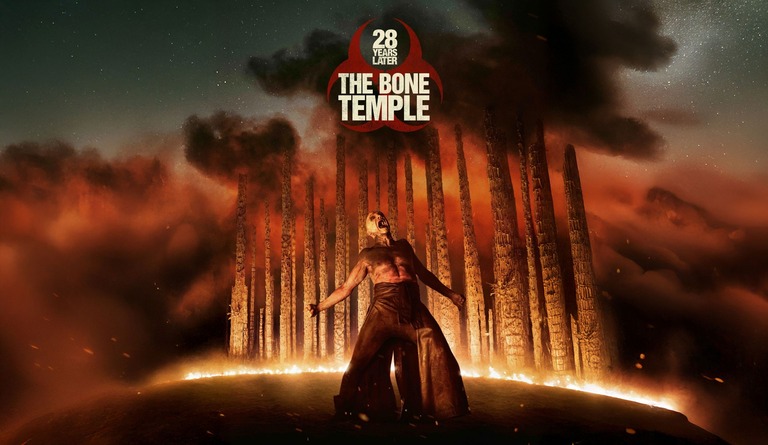
28 Years Later: The Bone Temple Review – A Solid Sequel!
Film trilogies have a special quality to them that allows its stories to be expanded, to introduce new worlds, and emotionally attach audiences to its characters and their journeys. They become the perfect storyboard for introductions, action, and climax that fits the perfect narrative structure. It also gives its stories a point of conclusion where the stakes seem higher knowing our heroes have an end point to defeat evil. Although 28 Days Later was released in 2002 with its sequel releasing five years after, 28 Years Later is a continuation of its original story while creating a new separate trilogy at the same time.
Related: Best Zombie Movies on OTT | Netflix, Amazon, Apple TV!
Having met our main protagonist Spike with the introduction of Dr. Kelson in the first film, 28 Years Later: The Bone Temple is a continuation of Spike’s story as he meets Jimmy Crystal and his gang of violent and sadistic humans posing an even bigger challenge for Spike as he still lives among the undead. The Bone Temple feels vastly different in its filmmaking and narrative endeavors, making it a highly engaging second feature in the trilogy with Nia DaCosta’s talents and flair as its focal point.
Nia DaCosta’s direction feels more personal in its endeavors. She utilizes close ups to analyze characters and the violence caused and inflicted on them in a graphic way. Where Danny Boyle’s direction of the first film felt in the realm of setting the scene (as a first film is usually used for) through location and setting camera shots, The Bone Temple examines added layers to Spike’s reality among the living and dead.
There is a much more human focus in this film that DaCosta exhibits steadying the camera in a more serious manner as opposed to chaotic to mirror the infected’s horror scenes. The introduction of Jimmy Crystal’s gang heightens the danger of the mainland for Spike and even Dr. Kelson as the infected become less worrisome in comparison.
28 Years Later: The Bone Temple plays tremendously as a sequel to 28 Years Later, leaning into its continuing story rather than trying to stand alone. However, it maintains the best qualities of a sequel in its continuation of deeper thematic elements that could only be colored by both films together. As the narrative continues, there is a clear clouding of morality and judgement balanced between the humans and infected where corruption of the body is at the forefront of the infected while corruption of the mind can be attributed to the humans.
Through the discovery of Jimmy being the young boy that sees his father perish in their church by the infected in the first film, Jimmy’s actions and methods of survival are never empathized with but more examined objectively. In this the audience sees how he and his gang are able to be manipulated mentally by their pasts and by Jimmy’s indoctrination. Also, as the infected are analyzed through Dr. Kelson and Sampson’s narrative, it is better shown how the dead have no choice in their actions and violence as opposed to Jimmy’s gang who takes it on willingly. This demonstration of the corruption of morals enhances the common apocalyptic idea of humans being more dangerous than monsters.
The Bone Temple maintains the first film’s strong emotional aspects including our ability to maintain our humanity even in the most dire circumstances. This is exhibited by Spike and Dr. Kelson’s relationship in 28 Years Later with the passing of Spike’s mother Isla (Jodie Comer) and in The Bone Temple, displaying how kindness and compassion can lead to someone’s downfall in a harsh and evil reality.
The film creates a harsh atmosphere for the first half, engaging in grotesque visuals as it pertains to the most vile of humans. But, just like the first film, it destroys our hearts in its search for humanity behind humans and the infected. 28 Years Later: The Bone Temple has the ability to differentiate from its predecessor but while keeping the strongest elements at its center. With a number of loose ends to tie up narratively and thematically, the 28 Years Later trilogy is well on its way to a conclusion that this critic hopes sticks as well as its two previous films.
‘28 Years Later: The Bone Temple’ Rating – 4.5/5

- Good Luck, Have Fun, Don’t Die Review: An Electric Sci-Fi Comedy! - February 20, 2026
- Wuthering Heights (2026) Review: An Underwhelming Spectacle! - February 19, 2026
- 28 Years Later: The Bone Temple Review – A Solid Sequel! - January 21, 2026


Pingback:Almost Us (2026) Review: Simple Yet Watchable! - Just for Movie Freaks
Pingback:Sentimental Value (2025) Review: A Spectacular Emotional Journey! - Just for Movie Freaks
Pingback:Tafiti: Across the Desert (2026) Review - Sweet & Warm! - Just for Movie Freaks